
PROJECT POST
October 6, 2026
A homeowner in Gold Canyon came to us through our website with a problem most people have never heard of until it happens to them: their artificial grass was burning, and the windows were doing it. This is a little bit different than usual issues that home window tinting solves.
Not sun damage in the general sense. A defined area of melted, warped turf, caused by sunlight reflecting off the glass of their own house and landing back on the lawn. There are several window tint options for solving this problem. We installed Pristine 70 on the exterior of five windows facing south and east, and the burning stopped.
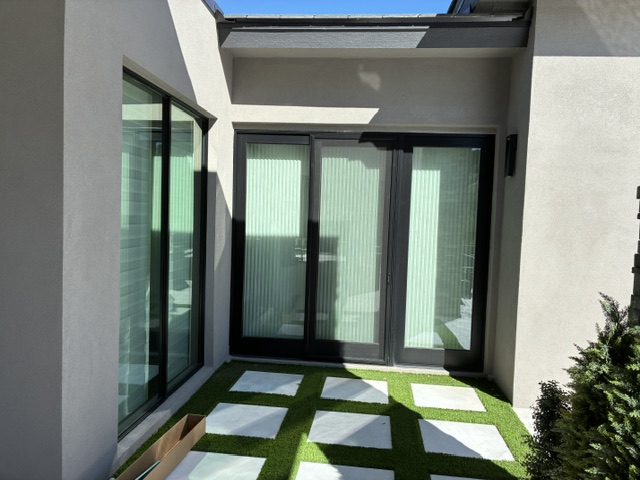
Turf burn from window reflection is a real and increasingly common problem, and it surprises people every time. The homeowner usually blames the turf, the installer, or the Arizona sun in general. The actual culprit is the glass.
Modern energy-efficient glazing is built to reflect solar energy rather than let it into the house, which is exactly what you want for your cooling bill. That reflected energy has to go somewhere. When it comes off a south- or east-facing pane at the right angle, it lands on whatever is in front of it, and if the pane has any slight bow to it, that reflection can be concentrated rather than scattered. Artificial grass is a synthetic fiber. Concentrated reflected sunlight is more than it can take, and the result is a scorched or melted strip across the lawn that will not grow back, because it was never growing in the first place.
Gold Canyon sits out past Apache Junction at the foot of the Superstitions, and like much of the east Valley it is full of newer homes built with energy-efficient glass and landscaped with artificial turf instead of grass that needs watering. Those two choices are individually sensible and occasionally a bad combination.
Add the Arizona sun, which is stronger and higher-angle than almost anywhere else these products get installed, and you have the conditions for turf burn: reflective glass, synthetic lawn, and an enormous amount of solar energy to work with. We see it across Gold Canyon, Apache Junction, Queen Creek, Mesa and the wider Phoenix metro, almost always on south- and west-facing elevations and almost always on homes under fifteen years old.
Tom specified Pristine 70, and the homeowner went with the recommendation.
The critical detail on this project is not the film. It is where it went. The film was installed on the outside of the glass, not the inside.
That is the opposite of a normal window tint job, and it is the only thing that works for this problem. Interior film sits behind the glass, so the sunlight has already hit the exterior surface and bounced away before the film has any say in it. Interior film is excellent at managing what comes into the house and does nothing at all about what reflects off it. Stopping a reflection means treating the surface doing the reflecting, which means going outside.
Five windows on the south and east elevations were treated, which were the ones putting reflection onto the turf.
Pristine 70 is a light film, and that is deliberate. The homeowner’s problem was not heat inside the house and it was not glare. It was one specific reflection hitting one specific area of lawn. Treating that does not require darkening the windows of the home, changing how the house looks from the street, or reducing the light inside the rooms. The right fix for a turf burn problem is the lightest film that interrupts the reflection, not the darkest film available.
Damon and Sam handled the install across the five affected windows.
Exterior film work is its own discipline. The installer is working on the weather side of the glass, where dust, wind and direct sun all have a say in how clean the application goes, and where the film has to be set without contamination in conditions that are actively trying to contaminate it. It is a different job from standing in an air-conditioned living room working on the inside of the same pane.
No more burning. The turf that survived is safe, and the homeowner did not have to re-landscape, rebuild a section of lawn every summer, or put up a structure to block their own windows.
If you have artificial grass with a melted stripe across it, look at the windows facing that stripe before you blame the turf. Our turf burn protection film page explains how we diagnose and treat it, and our residential window tinting page covers the rest of what film can do for a Phoenix-area home. The full range of window film options is there too.
If heat, glare, UV exposure, privacy, reflection damage or excessive sunlight is making your Phoenix-area home or commercial property less comfortable, AZ Max Tint can help you find the right window film for your space.
Call AZ Max Tint: (480) 913-5889
Contact AZ Max Tint: https://azmaxtint.com/contact
For directions to AZ Max Tint, just click here.
Driving directions from Gold Canyon, AZ 85118 to AZ Max Tint at 3734 E Kristal Way, Phoenix, AZ 85050.
Enter Your Information Below
Enter Your Information Below