

Decorative & Frosted Window Film: Style Meets Function for Arizona Homes and Offices
By AZ Max Tint
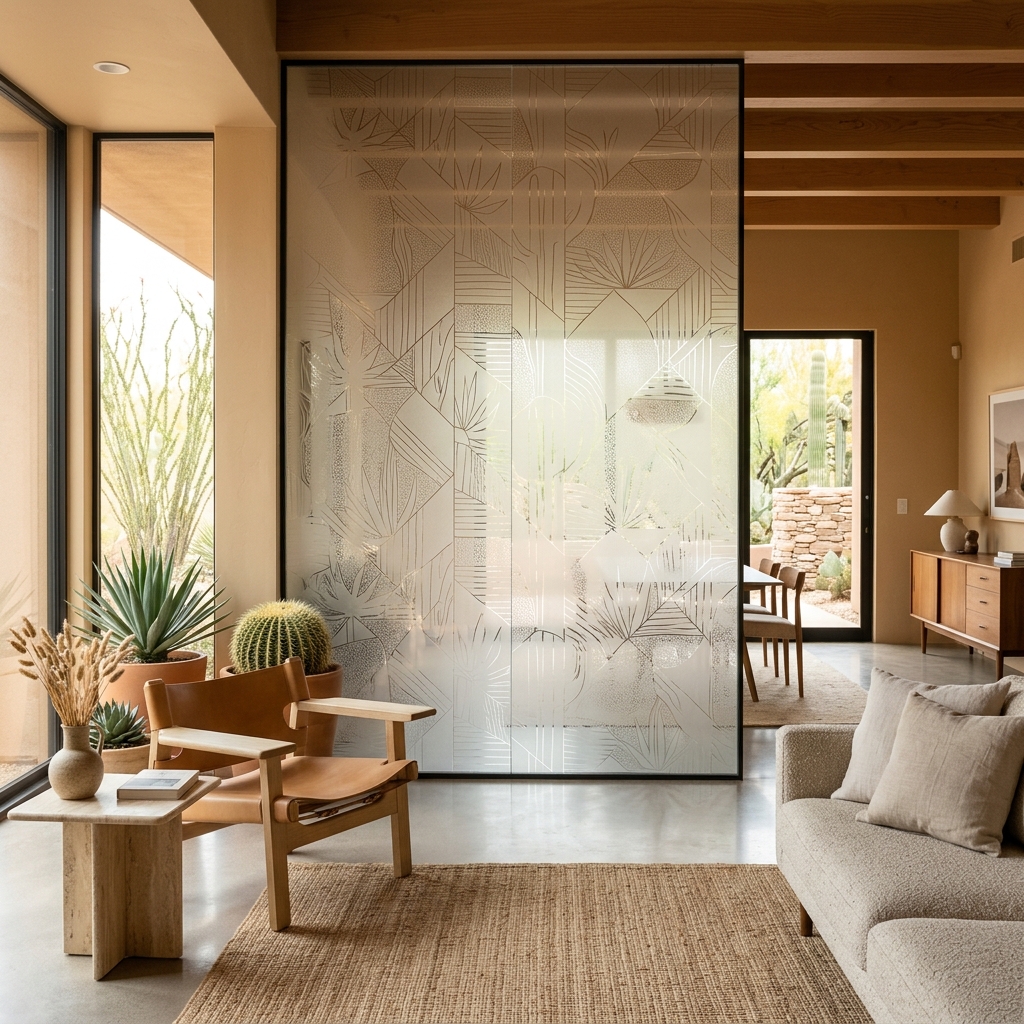
Most people first discover window film because of heat and energy bills. That makes sense in Arizona—our summers are brutal, and anything that keeps a room cooler is worth a serious look. But there’s a whole category of window film that often gets overlooked: decorative and frosted film.
These products aren’t primarily about heat. They’re about privacy, aesthetics, light diffusion, and design—and they do all of those things without requiring you to replace your glass, install blinds, or block out natural light entirely.
Here’s what decorative and frosted window film actually does, where it works best, and why it’s worth considering for your Arizona home or business.
What Is Decorative Window Film?
Decorative window film is a thin adhesive film applied directly to glass that alters its appearance without changing the glass itself. Unlike solar control films that are primarily engineered to reject heat, decorative films are designed with visual effect in mind—though many also offer UV protection and some heat reduction as a secondary benefit.
The main types include:
- Frosted film – Creates a smooth, uniform matte appearance. Lets light through while obscuring detail on the other side.
- Etched or sandblasted effect film – Mimics the look of expensive acid-etched or sandblasted glass at a fraction of the cost.
- Patterned film – Geometric shapes, lines, botanical motifs, or custom designs that make a statement while also providing privacy.
- One-way mirror / daytime privacy film – Allows clear viewing from one side (usually inside-out during daylight) while appearing reflective or obscured from the other.
- Color and gradient film – Tinted or gradient films that add a decorative touch to glass partitions, doors, or accent windows.
- Cut vinyl lettering and graphics – Used commercially for storefronts, conference rooms, and branded environments.
Why It Matters in Arizona Homes
Bathroom and Shower Windows
Bathrooms are the most obvious use case. Many Arizona homes have windows in bathrooms for natural ventilation and light, but standard clear glass offers no privacy. The traditional solution—frosted glass—requires a contractor, glass removal, and real expense.
Frosted window film achieves the same effect in hours, not days, at a fraction of the cost. And if you ever remodel and want a different look, the film can be removed cleanly without damaging the glass.
Front-Facing and Street-Level Windows
In many Arizona neighborhoods—especially in newer subdivisions where homes sit close together—street-facing windows can feel exposed. Daytime privacy films let you see out while preventing passersby from seeing in when the sun is up.
These films look nearly identical to clear glass from a distance, so there’s no aesthetic trade-off from the exterior.
Entry Sidelights and Door Glass
Narrow glass panels flanking a front door are a classic design element—and a classic privacy problem. Frosted or etched film on sidelights lets light filter through while blocking the view into your entry or hallway.
Home Offices and Media Rooms
If your home office has a glass partition, French doors, or sidelights into a common area, frosted or patterned film creates a visual separation that signals “I’m working” without sealing off the room entirely. It also reduces reflections and glare on screens.
Interior Glass Partitions and Closet Doors
Arizona contemporary homes increasingly use interior glass walls, sliding glass partitions, and glass closet doors. Decorative film lets you add pattern, privacy, and texture to these surfaces without replacing the glass or eliminating the light-transmitting benefit they were installed for.
Why It Matters for Arizona Businesses
Conference Rooms and Private Offices
Glass-walled meeting rooms are standard in modern offices—but full transparency into every meeting can undermine focus and confidentiality. Frosted film on the lower half (or cut vinyl branding at eye level) is a practical solution that preserves the open feel while providing a visual barrier during meetings.
Storefronts and Retail
Retail businesses in Arizona strip centers often have large window frontages that are great for visibility—until the afternoon sun makes the interior unbearable to look at from outside. Decorative solar control hybrid films can balance solar rejection with an attractive finish that brands the space.
Simple vinyl cut logos, hour graphics, or branded patterns on front windows are also professional, cost-effective, and removable.
Medical, Legal, and Financial Offices
Waiting rooms and reception areas often need a balance between openness and patient or client privacy. Partial-height frosted film on glass partitions signals confidentiality without making the space feel closed off.
Dispensaries and High-End Retail
For dispensaries and specialty retailers that need to limit visibility into their space, decorative film paired with security film solves two problems at once: privacy and smash-and-grab deterrence.
Decorative Film vs. Real Etched Glass: Is There a Difference?
Functionally, not much—especially for interior applications.
Genuine acid-etched or sandblasted glass is beautiful, but it’s heavy, expensive to produce, requires professional installation, and is permanent. If your design needs change or you’re in a leased space, replacing it is another large expense.
Decorative film:
- Costs dramatically less to supply and install
- Can be removed and replaced without damaging the underlying glass
- Available in far more patterns than most glass etch options
- Installable quickly — usually same-day for most residential and small commercial applications
- Holds UV-blocking properties that real etched glass doesn’t include
The main trade-off is longevity: etched glass is permanent and maintenance-free. Quality decorative film, professionally installed with the right product, typically lasts 10–15 years in normal indoor conditions. For exterior applications, solar-grade films are used that are rated for the Arizona climate.
How to Choose the Right Film for Your Space
Start with your goal
Are you primarily after privacy? Aesthetics? Light diffusion? Or a combination? The answer shapes which product class makes sense.
For pure privacy in a bathroom or sidelight, a simple frosted film is usually the right call. For a conference room in a corporate office, you might want a patterned film with a company logo. For a retail storefront, you might want a tinted solar-control film with graphic elements.
Think about light transmission
Frosted films vary in how much light they let through. A heavy frost blocks more detail but also reduces visible light more than a lighter, translucent frost. If the goal is daylight without visibility, choose a film with high visible light transmission (VLT) and low haze depth.
Consider the glass type
For double-pane windows, film selection requires care—the wrong film can increase thermal stress on the glass seal. (We covered this in detail in our post on thermal shock and double-pane windows.) A professional installer should assess your glass before recommending a decorative product.
Interior vs. exterior application
Most decorative films are designed for interior surface application, which protects the film from Arizona’s UV exposure and temperature swings. Exterior-grade decorative films exist for applications where interior installation isn’t feasible, but they require products specifically rated for direct sun and heat cycling.
HOA and commercial lease considerations
Some Arizona HOAs restrict visible exterior changes to windows. Daytime-privacy reflective films or decorative films with a strong exterior appearance could potentially conflict with HOA rules. Ask your installer about film options that maintain a neutral exterior look while still achieving your interior goals.
For commercial tenants, always check your lease—some landlords require approval for any window modification. Frosted and decorative films are almost always removable, which typically makes this a straightforward approval.
Is Installation Disruptive?
No—this is one of the advantages of film over glass replacement. A professional installation for a typical bathroom window or a set of conference room glass panels takes a few hours. The process involves:
- Cleaning the glass thoroughly
- Cutting the film to exact dimensions
- Applying the film with a slip solution
- Smoothing out moisture and air pockets with a squeegee
- Trimming edges cleanly
There’s a brief cure period (usually a few days in Arizona’s climate) where the film may look slightly hazy or show water pockets—this is normal and clears on its own as moisture evaporates.
A Note on DIY vs. Professional Installation
Frosted films are among the simpler films to find in big-box stores, and some homeowners do DIY installations on smaller windows with decent results. The challenge increases with:
- Large panes — any dust or debris trapped under the film is immediately obvious on a frosted surface
- Complex shapes — arched windows, irregular sidelights, or glass partitions with hardware require precise cutting
- Pattern-matched films — decorative patterns have repeat cycles and need to align properly
For small bathroom windows, a DIY approach is reasonable if you’re handy. For anything larger, a professional installation gives you a cleaner result, a guarantee on the work, and the right product recommendation for your specific glass.
Ready to Add Decoration or Privacy to Your Glass?
Decorative and frosted window film is one of the most versatile tools available for both residential and commercial spaces in Arizona. Whether you want bathroom privacy, conference room seclusion, a branded storefront look, or just a more polished aesthetic for your glass interior walls—there’s a film for it.
AZ Max Tint serves residential and commercial clients throughout the Phoenix metro area and across Arizona. If you have a glass surface you’d like to transform, get in touch and we’ll help you find the right film, pattern, and finish for your space.