
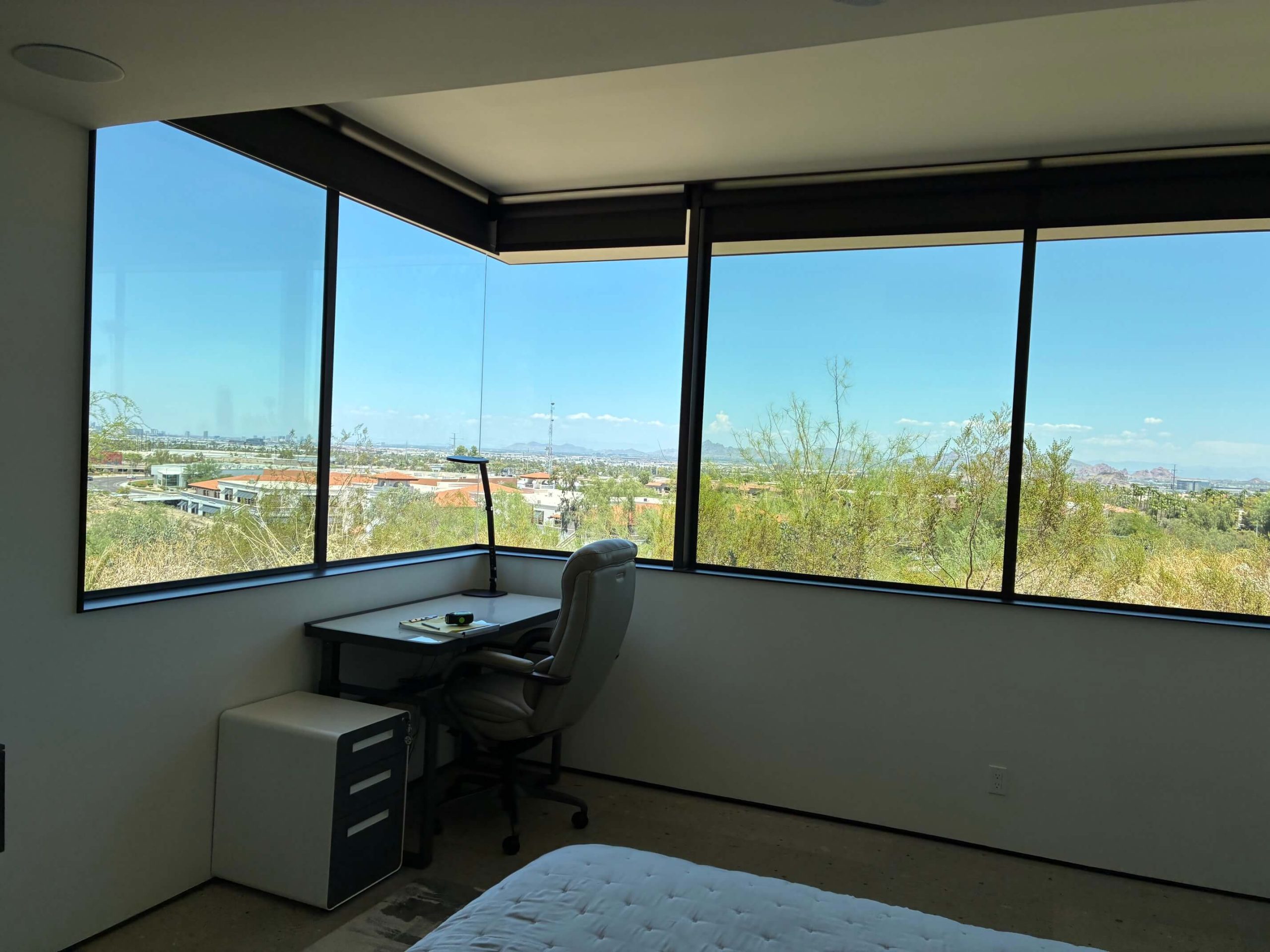
If you own a home in the Valley, you know the summer routine: the AC never really shuts off, the west-facing blinds stay closed from April to October, and the utility bill arrives with a number you’d rather not look at.
Window tinting is one of the highest-return fixes for that problem. But a warning stops a lot of Phoenix homeowners cold — from a forum thread, a neighbor, or the fine print in their window manufacturer’s warranty:
Window film can cause your glass to crack.
The phenomenon is real. It’s called thermal shock, and it does happen — but only when the wrong film goes on the wrong glass. With the correct film and a professional installation, tinting double-pane windows in Phoenix is safe, and it’s one of the most effective upgrades available for a house that faces 110°F afternoons.
Here’s what’s actually going on.
Short answer: Yes, you can tint double-pane windows. Thermal shock happens when a heat-absorbing film drives up the temperature of the glass. Heat-reflecting films — reflective and ceramic — redirect solar energy before it loads into the pane, which is why they’re the standard choice for double-pane glass in Phoenix.

“Vacuum insulating glass” is available on Wikimedia Commons under the Creative Commons Attribution-ShareAlike license [5].
Most homes built in the Valley since the 1990s use Insulated Glass Units (IGUs) — two panes sealed together around a pocket of air or argon. That gas pocket is the insulation, slowing heat transfer between a 112°F patio and a 76°F living room.
Thermal shock happens when one part of a single pane gets dramatically hotter than another part of the same pane. The center of the glass, sitting in direct sun, expands. The edges — tucked inside the shaded window frame — stay cooler and don’t. Glass has almost no tolerance for that kind of internal disagreement. When the stress exceeds what the pane can absorb, it fractures.
The signature is easy to recognize: a crack that starts at the frame edge and curves outward in a wavy line, not a straight line and not a starburst from an impact point.
The operative word in “window film can crack your glass” is can. It’s a conditional, and the condition is the film.
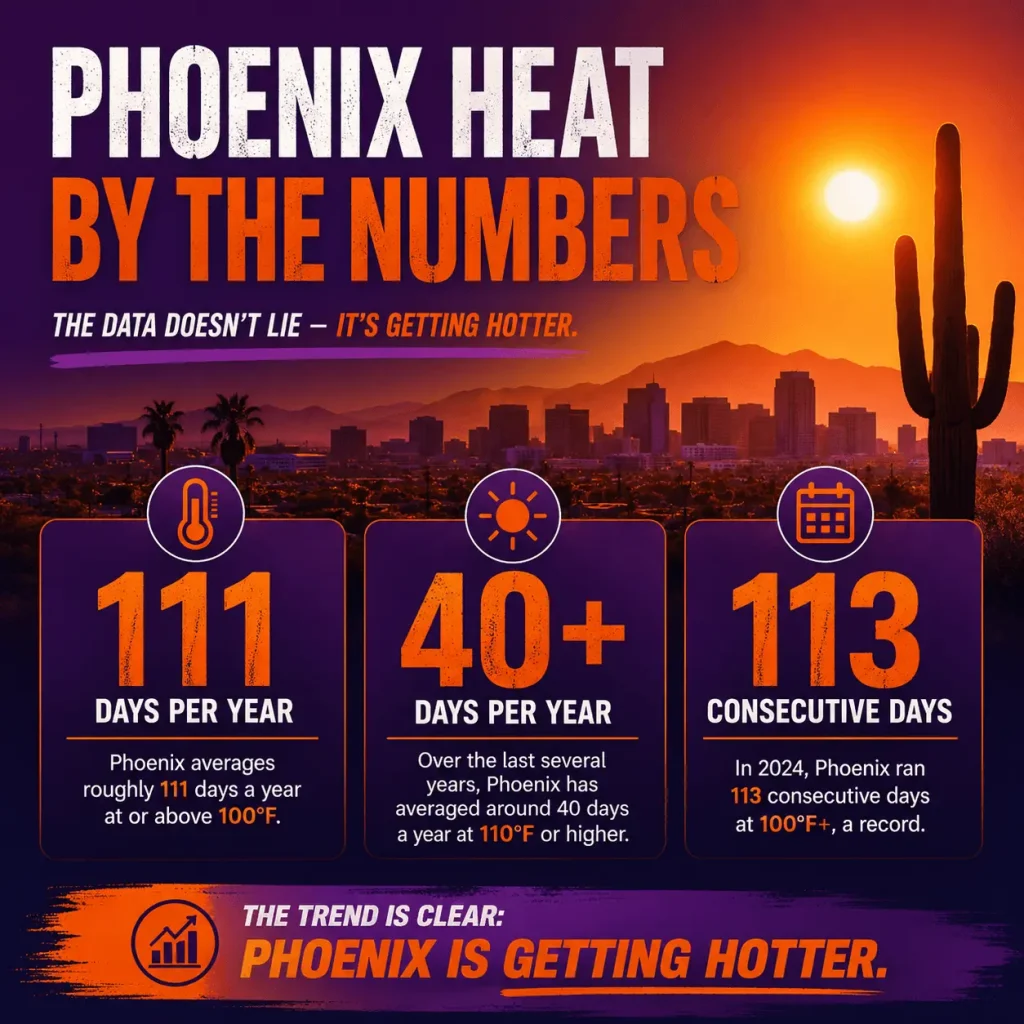
Thermal shock is a temperature-differential problem, and no major U.S. city produces bigger differentials than this one.
Phoenix averages roughly 111 days a year at or above 100°F, and over the last several years the city has averaged around 40 days a year at 110°F or higher — figures that are climbing, not holding steady. In 2024, Phoenix ran 113 consecutive days at 100°F+, a record.
Three things make Valley glass a specific case:
This is exactly why a film that performs fine in Portland can be a liability here. Phoenix is not a normal window film market, and the film selection shouldn’t be a normal one either.
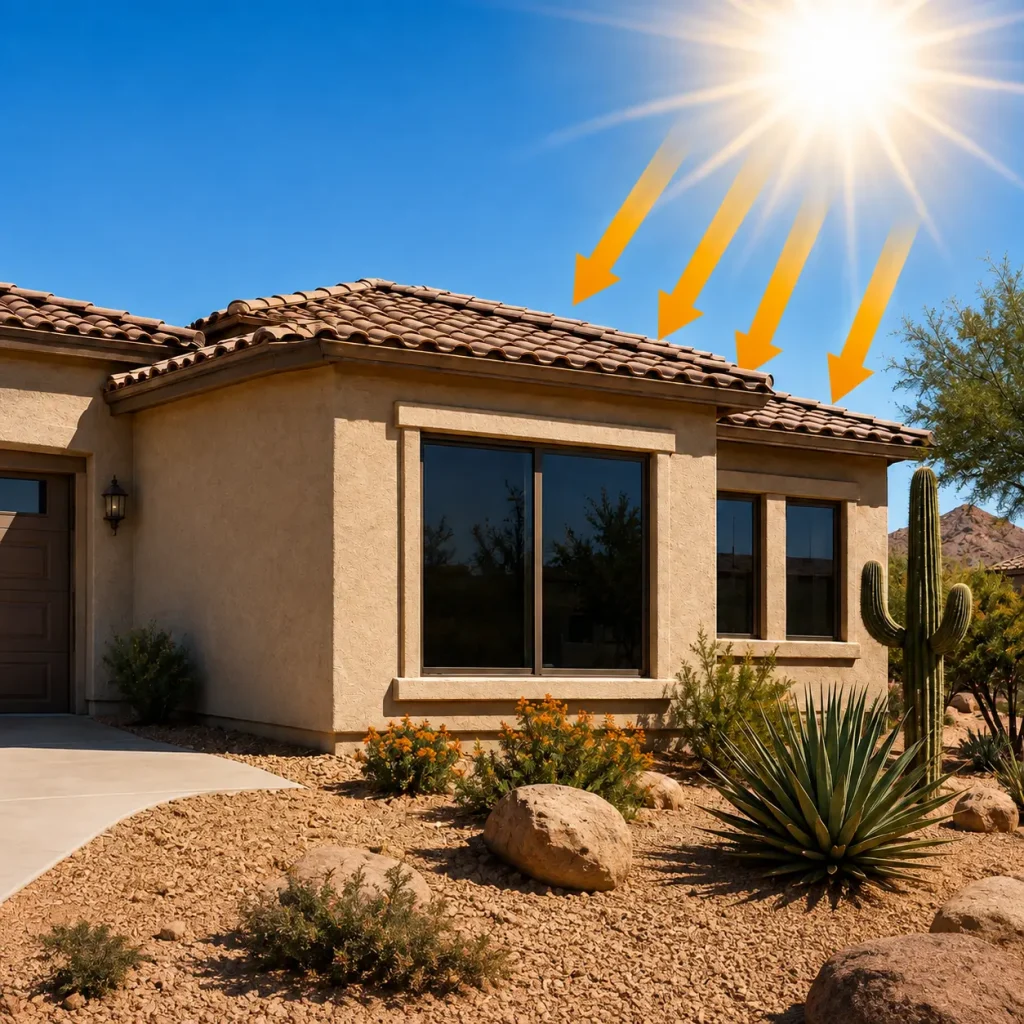
Window films handle solar energy one of two ways. They absorb it, or they reflect it. That single distinction is the whole story.
Absorptive films — cheap dyed products, most off-the-shelf automotive tint, and the rolls sold at big-box hardware stores — soak up solar energy and hold it in the glass. The film gets hot, the glass gets hot, and the pane’s center-to-edge temperature gap widens. On a 115°F afternoon in Ahwatukee, that’s the precise recipe for a thermal fracture in a double-pane window.
These films are why window tinting has the reputation it has. They’re still on the shelf, they’re still inexpensive, and they’re still the wrong answer for an IGU in Arizona.
If you want the full list of things people believe about tint that aren’t true, we’ve covered them in 5 common misconceptions about window tinting in Arizona.

For double-pane glass in this climate, the film needs to send solar energy back out before it loads into the pane.
Reflective films use microscopic metallic layers to bounce a large share of solar energy away from the glass entirely. Because the energy never fully enters the first pane, glass temperatures stay in a safe band. The trade-off is appearance — reflective film reads as a mirror from outside, which some homeowners want for daytime privacy and some don’t. If the exterior look appeals to you, that’s mirror window tint.
Ceramic films are the default recommendation for most Phoenix homes. Instead of metal, they use non-conductive ceramic nanoparticles to filter infrared heat and UV while leaving visible light largely alone. You get serious heat rejection without the mirrored exterior and without signal interference. The view out your window stays a view.
Two related pages worth reading if you’re choosing between products: our breakdown of ceramic vs. carbon window film, and our page on UV window tint if fading floors, art, and furniture are the concern driving the project.
Film manufacturers are explicit about this. LLumar’s architectural film FAQ states plainly that window film is safe for dual-pane windows and most types of low-e glass, with the caveat that product selection should be matched to the glass by a dealer.

“Innerglass-low-e-illustrati.jpg” is available on Wikimedia Commons and licensed under the Creative Commons Attribution-Share Alike license [1]
A lot of newer Phoenix construction — and most window replacements done in the last fifteen years — uses low-emissivity (low-E) coated glass. Homeowners with low-E windows often assume film is either redundant or forbidden.
Neither is quite right. Low-E coatings and window films do overlapping but not identical jobs, and the coating’s position within the IGU affects which films are appropriate. Some combinations are fine. Some raise the absorption profile of the unit and need to be avoided. There are published compatibility resources on applying film to low-E and tinted glass, and installers work from glass compatibility charts that cross-reference glass type against film type.
The practical takeaway: if you have low-E glass, that isn’t a reason to skip film. It’s a reason to make sure whoever quotes you knows what’s in your window openings before they quote a product.
This is the question we get most, and it deserves a direct one.
Major manufacturers — Milgard, Pella, Andersen — typically include language stating that aftermarket window film voids their coverage for glass breakage or seal failure. That’s real, and it’s in the paperwork.
That blanket language exists because manufacturers can’t underwrite the risk of a homeowner applying an unknown film from a hardware store to an unknown piece of glass. It isn’t a technical verdict that film destroys IGUs.
Here’s the part that matters: when the work is done by a licensed professional using a premium film, the film manufacturer’s warranty steps in behind the glass and the seals, matching the terms of your original window coverage. You aren’t giving up protection — you’re transferring it to a product engineered for the conditions the film is being asked to handle. AZ Max Tint installs SunTek film, which carries that manufacturer backing.
Ask any installer you’re considering to put the film warranty terms in writing before you sign. If they can’t, that tells you something.

A competent estimate is a survey, not a square-footage measurement. Four variables drive the film recommendation:
Glass type. Standard annealed glass carries less thermal tolerance than heat-strengthened or tempered glass. Knowing which one is in each opening determines what film can safely go on it.
Shade patterns. This is the counterintuitive one. Partial shade increases thermal shock risk. A palo verde that shades the top half of a west window while the bottom half bakes creates two very different temperatures in one pane at the same moment — a bigger stress load than full sun on the whole pane. Phoenix’s mature-landscaping neighborhoods are full of these windows.
Frame material. Vinyl, aluminum, and wood expand at different rates and hold heat differently. Aluminum frames in particular, common in older Valley homes, conduct heat straight into the glass edge.
Orientation. West-facing openings carry the worst of it in Arizona. South exposures shift seasonally. North-facing glass is often a non-issue. Orientation determines which rooms actually need aggressive film and which don’t — and a good estimate will tell you where not to spend money.
If you want the return-on-investment side of this, we broke it down in home window tinting: the underrated upgrade that pays you back.
Thermal shock is real, and it’s avoidable. The gap between a cracked window and a materially cooler house comes down to two decisions: the right film, installed correctly.
The DIY rolls at the hardware store are designed for car windows, not insulated glass units, and they’re the high-absorption products that create the problem in the first place. Professional ceramic and reflective films are engineered for residential glass in demanding climates and come with warranties that reflect that.
The payoff is worth the diligence. According to U.S. Department of Energy figures cited by LLumar, solar heat gain through windows accounts for roughly a third of a building’s cooling cost — and in a city that runs air conditioning eight months a year, a third is a large number.
AZ Max Tint has been tinting glass across the Valley for over 30 years. Before we recommend a product, we look at your glass type, shade patterns, frame construction, and sun exposure, because the right film for a west-facing Arcadia great room isn’t the right film for a north-facing bedroom two miles away.
Explore our residential window tinting services, browse the full specialty window film lineup, or — if this is a storefront or office rather than a house — see commercial window tinting.
Ready for a straight answer about your specific windows? Request a free estimate or call (480) 913-5889. We’ll walk the house, tell you which openings actually need film and which don’t.
AZ Max Tint provides professional residential and commercial window tinting throughout the Greater Phoenix area, including Scottsdale, Mesa, Chandler, Gilbert, Tempe, and Peoria.
Can you put window film on double-pane windows? Yes. Double-pane windows can be tinted safely when the film is matched to the glass. The risk comes from heat-absorbing films, not from film in general — reflective and ceramic films redirect solar energy rather than storing it in the pane.
What causes thermal shock in a window? A large temperature difference between the center of a pane and its edges. The sunlit center expands while the frame-shaded edge stays cooler, and the resulting stress can fracture the glass. Cracks from thermal shock typically start at the frame edge and curve outward.
Does window film void a window warranty? Most manufacturers’ warranties contain language excluding coverage after aftermarket film is applied. When a licensed installer uses a premium film, the film manufacturer’s warranty covers the glass and seals in its place, matching the original terms.
Is ceramic or reflective film better for Phoenix homes? Both are safe for double-pane glass. Ceramic film rejects heat without changing how the window looks from outside. Reflective film rejects more energy but reads as a mirror from the exterior and adds daytime privacy. The right choice depends on the exposure and the look you want.
Can you tint low-E windows? In most cases, yes — but the coating type and its position inside the insulated unit determine which films are appropriate. Have the glass identified before a product is quoted.
Commercial Window Tinting in Arizona: How It Can Lower Cooling Costs
Ceramic vs. Carbon Window Film: Which Is Right For Your Property
Enter Your Information Below
Enter Your Information Below