
Blog Article

If you have started shopping for window film in the Valley, you have run into this choice. Carbon costs less. Ceramic costs more. Every installer has an opinion, and most of them sell you the one they stock.
Both are legitimate products and both are a large improvement over the dyed film they replaced. The question is not which is better in the abstract. It is which one earns the price difference on your glass, in a climate that puts windows through 110°F afternoons about forty days a year.
Short answer: carbon film is a solid mid-tier choice that rejects heat well and never fades. Ceramic rejects substantially more infrared heat at the same visible light level, does not interfere with signal, and handles extreme exposure better. In Phoenix, the gap between them is widest on west and southwest glass — which is exactly where most of your heat load lives.
Carbon film suspends carbon particles in the film layer rather than using dye or metal. That construction gives it two properties that matter.
First, it does not fade. The color is structural, not a dye that breaks down under UV, so carbon film will not turn purple the way cheap dyed film does. Second, it contains no metal, so it does not interfere with cell signal, Wi-Fi, or garage door remotes.
Carbon rejects heat primarily by absorbing infrared energy and giving it a matte, non-reflective finish that many homeowners prefer aesthetically. For north- and east-facing glass in Phoenix, or for a homeowner working to a fixed budget who wants meaningful improvement across the whole house rather than premium film on two windows, carbon is a genuinely sensible answer.
Because carbon works partly by absorption, it holds more solar energy in the glass than a reflective or ceramic product does. On most windows this is a non-issue. On a double-pane unit facing directly into a Phoenix afternoon, glass temperature matters more than it does elsewhere — which is the subject of our piece on double-pane windows and thermal shock. Film selection on insulated glass should always be matched to the specific unit.
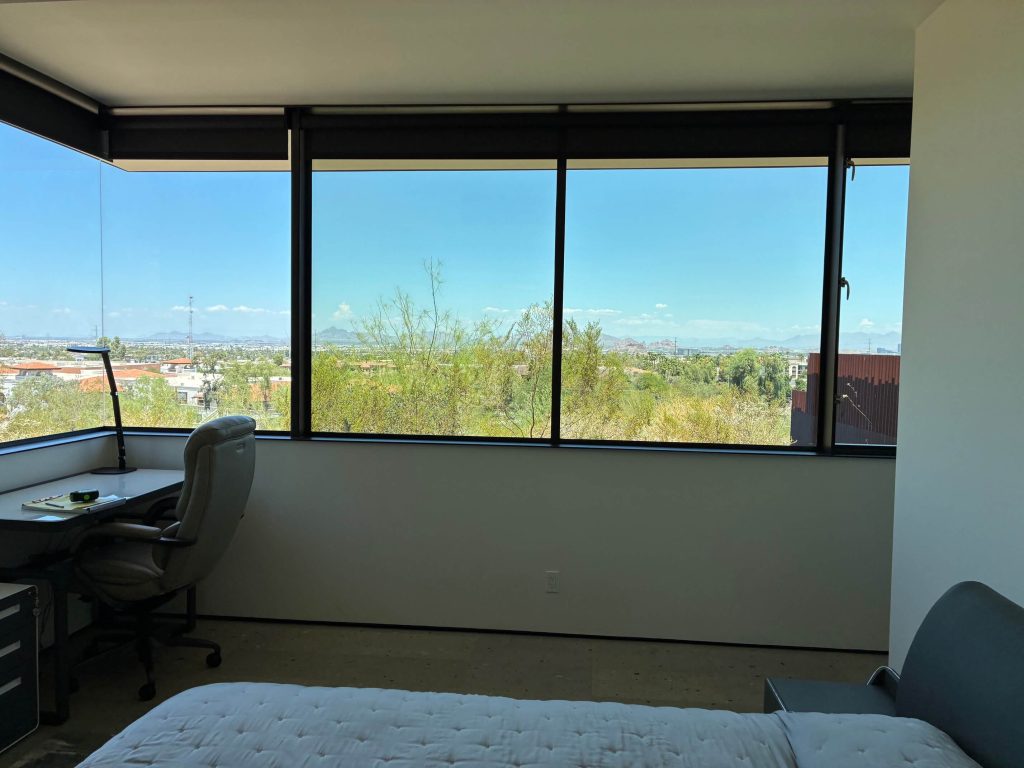
Ceramic film uses non-conductive ceramic nanoparticles instead of dye, carbon, or metal. The particles filter infrared radiation — the part of sunlight you feel as heat — while allowing visible light through.
That separation is the whole value proposition. With dyed film, cutting heat means cutting light: you get a darker room. With ceramic, you can reject a large share of solar heat while keeping a window that still looks like a window. For a Phoenix homeowner who wants their great room to stop feeling like a greenhouse without turning it into a cave, that is the entire point.
If fading is the specific problem you are solving rather than heat, look at UV window tint directly.
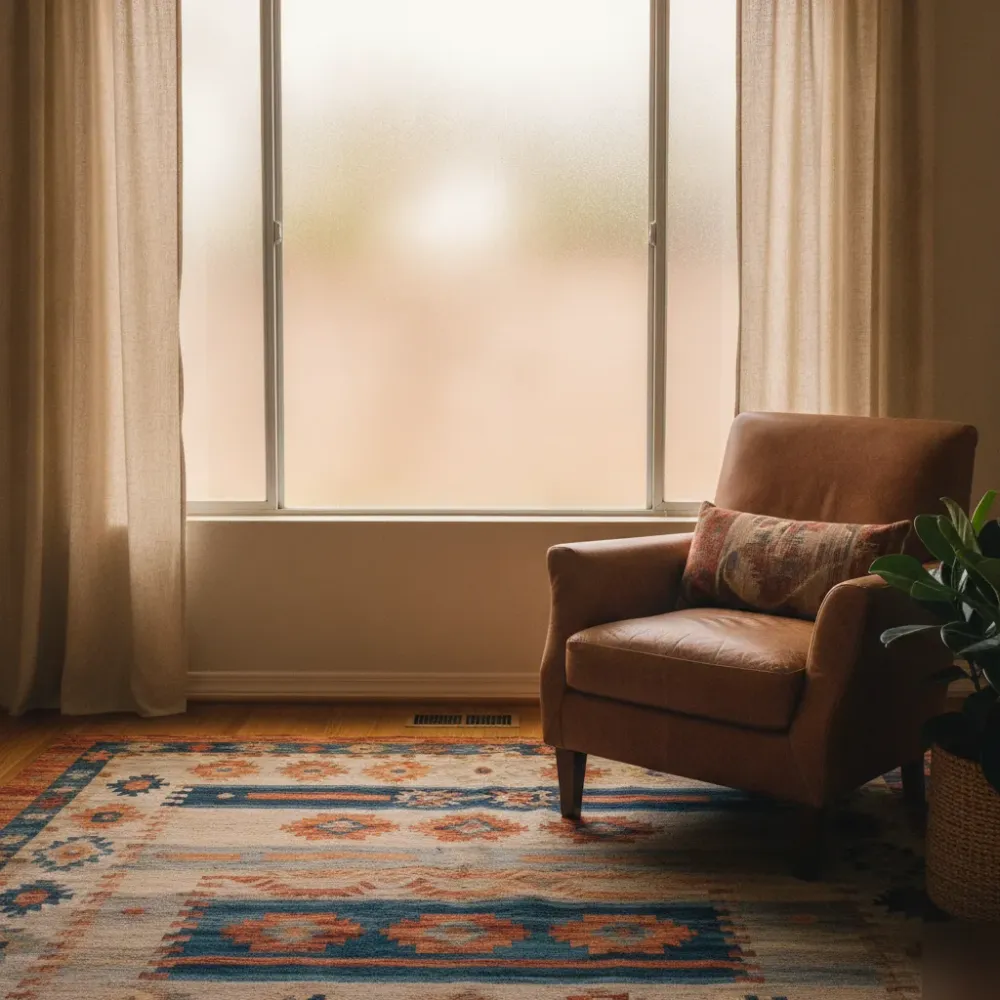
Manufacturers publish compatibility guidance for matching film to glass type, and professional installers work from glass compatibility references rather than applying one product everywhere.
This is where most comparison articles stop being useful, because the right answer depends on your specific house.
Plenty of Phoenix housing stock from the 1960s through the 1980s still has single-pane glass in aluminum frames. Aluminum conducts heat straight into the glass edge, and single-pane offers no insulating gas layer at all. These homes see the largest absolute comfort improvement from film of any category, and ceramic on the west elevation typically delivers the most noticeable change per dollar.
Homes built or re-windowed in the last fifteen years usually have low-emissivity coated double-pane units. Film still adds value here, particularly for glare and UV, but the coating type and its position inside the insulated unit determine which products are appropriate. This is a case where the glass genuinely needs to be identified before a product is quoted.
West and southwest glass takes low-angle direct sun from roughly 3 PM to sunset, during the hottest hours of a Phoenix day. South exposure shifts seasonally. North-facing glass often does not justify premium film at all. A sensible spec for many Valley homes is ceramic on west and south, carbon on east, and nothing on north — which costs less than filming everything in one product and performs better.

If you are still weighing whether film is worth doing at all, our piece on the myths that stop Phoenix homeowners from tinting covers the objections we hear most.
On west and southwest exposure, generally yes — that is where the performance gap between ceramic and carbon is largest. On north-facing glass the difference is small enough that carbon is often the better value. The honest answer depends on which windows you are filming.
Yes. At the same visible light transmission, ceramic rejects more infrared energy. To match ceramic’s heat performance, carbon generally has to go darker, which means a dimmer room.
Not when the film is matched to the glass. Thermal stress risk comes from heat-absorbing films on insulated units in high-exposure positions. Ceramic and reflective products redirect solar energy rather than storing it in the pane, which is why they are the standard choice for double-pane glass in Phoenix.
Neither does. Both are non-metallic. Signal interference is associated with metalized films, which use conductive metal layers.
Premium film is engineered for long-term installation, with lifespan depending on film type, glass type, exposure, and climate. Manufacturers back their products with factory limited warranties against peeling, bubbling, and color failure.
Whether ceramic or carbon is right for your property, the specification should follow from your glass, your exposure, and your goals. See our residential window tinting and commercial window tinting services, browse the full specialty window film range, or request a free estimate and we will walk the property and tell you exactly which film belongs on which opening.
Enter Your Information Below
Enter Your Information Below