
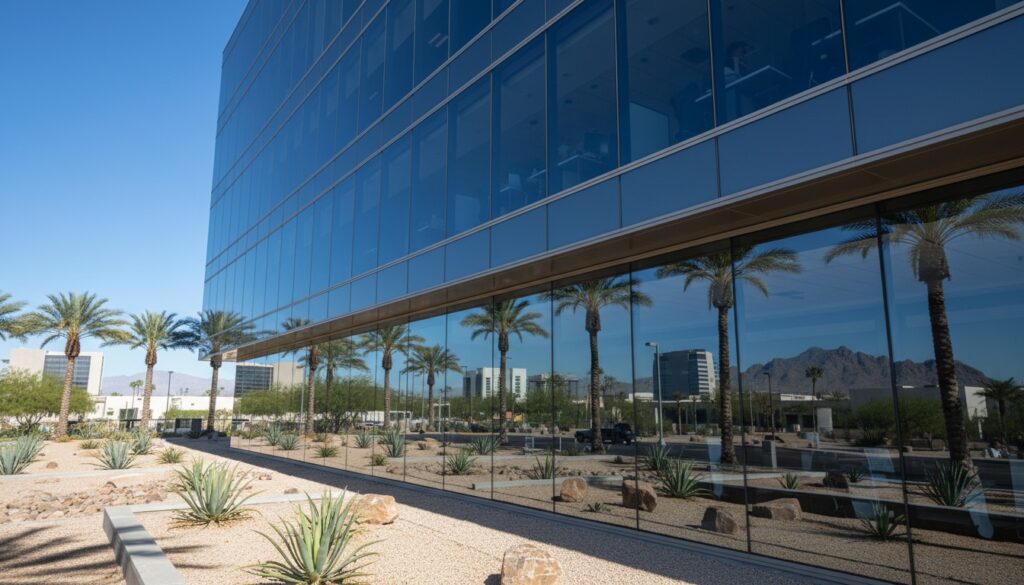
Walk into a Phoenix retail space at 4 PM in July and you can usually tell which windows face west. The staff have angled a display away from the glare. A section of merchandise near the front has lost its color. Someone has propped a sign to block the sun, which also blocks the view of the street.
None of that shows up as a line item. It shows up as merchandise you discount, displays that photograph badly, and a section of your floor that customers walk past instead of into.
This piece is about two specific problems: glare that degrades how people work and shop, and UV that fades what you are trying to sell. Cooling cost and glass security are real commercial film topics too, and they are covered separately — links at the end.

Phoenix businesses with meaningful glass frontage and daytime operations: retail, restaurants and cafes, salons and spas, showrooms, galleries, professional offices with perimeter workstations, and medical waiting areas. If your customers or staff spend the afternoon within a few feet of glass, this applies.
Glare is insidious because people adapt to it rather than report it. Staff reposition monitors, tilt screens, squint, and eventually stop mentioning it. The cost is real anyway.
In Phoenix the geometry is specific. West and southwest glass takes low-angle direct sun from roughly 3 PM until sunset. Low-angle means it comes in almost horizontally, straight at eye level and straight onto screens and display surfaces — not overhead where an awning would catch it. That is also, for most retail and hospitality, the busiest part of the day.
What that costs you in practice:
Solar control film reduces glare across the whole glazed area without closing it off. Glare reduction scales with how much visible light the film blocks, so specification is a genuine tradeoff — enough to fix the problem, not so much that you lose the display.

This is the one with a direct inventory number attached, and most owners underestimate it because it happens gradually.
Fading is driven by three parts of sunlight working together: ultraviolet radiation, visible light, and infrared heat. UV is the largest single contributor. Quality solar control film blocks up to 99% of UV rays, and also tempers the infrared and visible light that contribute the remainder.
What fades fastest in a Phoenix storefront:
The pattern to look for is a gradient: the same SKU is fine at the back of the store and marked down at the front. That gradient is your window, and it repeats every season until the glass is treated.
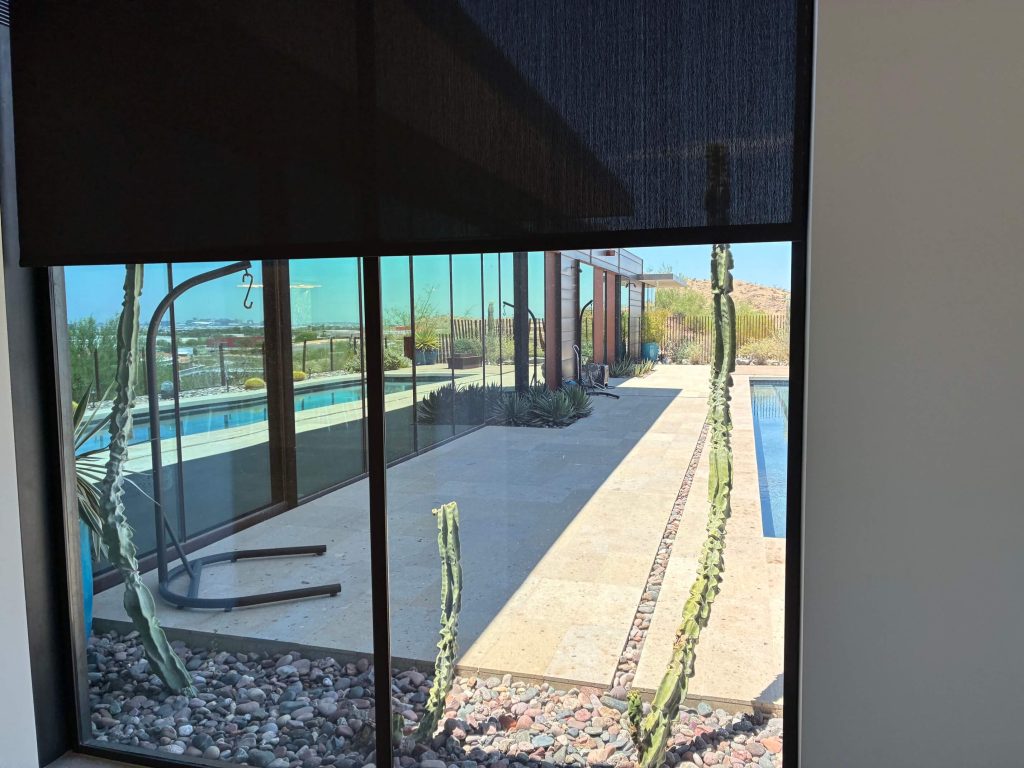
The instinct is to go dark. For a retail business that is usually the wrong call, because your glass is doing marketing work as well as enclosure work.
Spectrally selective and ceramic products reject infrared heat and filter UV while transmitting most visible light. That is what lets you cut glare and fading without turning your frontage into a mirror or a wall. Our comparison of ceramic vs. carbon film covers how those products differ.
Where you do want opacity, choose it deliberately. One-way window tint gives daytime privacy while preserving the outward view — useful for offices and treatment rooms. Frosted film handles partition and lower-panel privacy without darkening the space. Those are design decisions, not heat decisions.
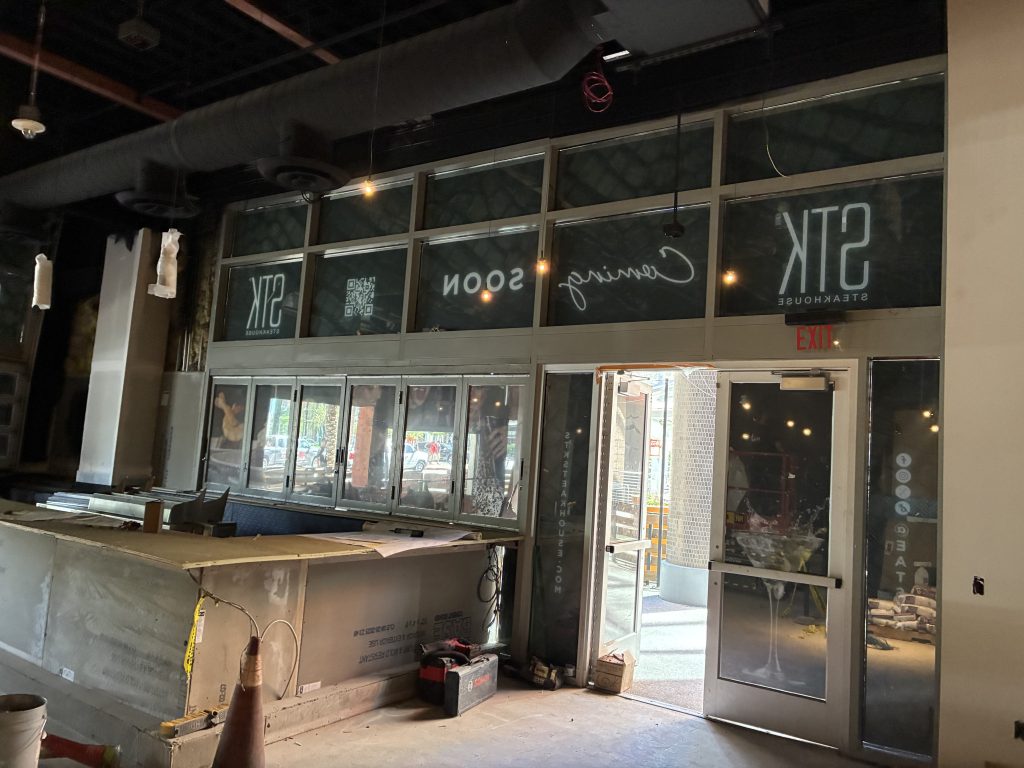
An assessment walks each elevation, identifies glass type, notes exposure and existing shading, and records what the space needs to function. A specification follows from that — often different products on different elevations rather than one film everywhere.
Film is cut to the glass and applied to the interior surface with water-based solution. Most commercial jobs are phased so trading continues. A short curing period follows, during which slight haze or small water pockets are normal and clear on their own; Arizona’s dry air tends to shorten that window compared with humid climates.
Glare and fading are the daily operational costs of untreated commercial glass. They are not the only ones:
Most Phoenix businesses have more than one of these problems, and scoping them together is usually cheaper than solving them one at a time.
See our commercial window tinting services, browse UV window tint for fade protection, or request a free estimate. We will walk the space and tell you which glass is costing you money.
Enter Your Information Below
Enter Your Information Below