Categories
Commercial Window Tint Residential Window Tint

How Much Does Home and Commercial Window Tinting Cost in Phoenix?

Blog Article

How Much Does Home and Commercial Window Tinting Cost in Phoenix?
calendar_today
By AZ Max Tint
AZ Max Tint - Home Window Tint - Phoenix Arizona 3

Why There Isn’t One Flat Price

Window film pricing isn’t one flat number. It depends on your home or building, plain and simple. Five things move the figure more than anything else.

How many windows. A single front door and a whole two-storey house are different jobs. Most of the quotes we write cover a handful of problem windows rather than every pane in the building.

How big the glass is. Three large picture windows take more film and more careful handling than a dozen small ones, and a full-height slider is its own kind of work.

Where the glass sits and how we reach it. Ground-floor windows are straightforward. Upper tiers, stairwell glass and anything needing a ladder or a lift add time to the job.

Which film the job actually calls for. A room that needs heat and glare control is a different product from a bathroom that needs privacy, and the films are not priced the same.

How much cutting and detail is involved. Straight rectangular panes go quickly. Arches, sidelights, frameless shower glass and custom decorative patterns take longer and cost more.

Check Out Our Latest Projects
What It Costs by Project Size

Here is how real projects have broken down. These are completed jobs, not estimates borrowed from a national average.

Scope of workTypical range
A door, or one or two windows$250 – $575
One room, three to five panes$575 – $1,000
One exposure, or several rooms$1,000 – $2,000
Whole home$1,800 – $5,000
Large or custom home$5,000 and up
Commercial storefront or office$1,200 – $3,500

Residential work and commercial work overlap more than people expect. The typical home lands around $1,400 and the typical commercial job around $2,200, but we have done $255 commercial jobs and $5,000 residential ones. Square footage matters far less than which windows are causing the problem.
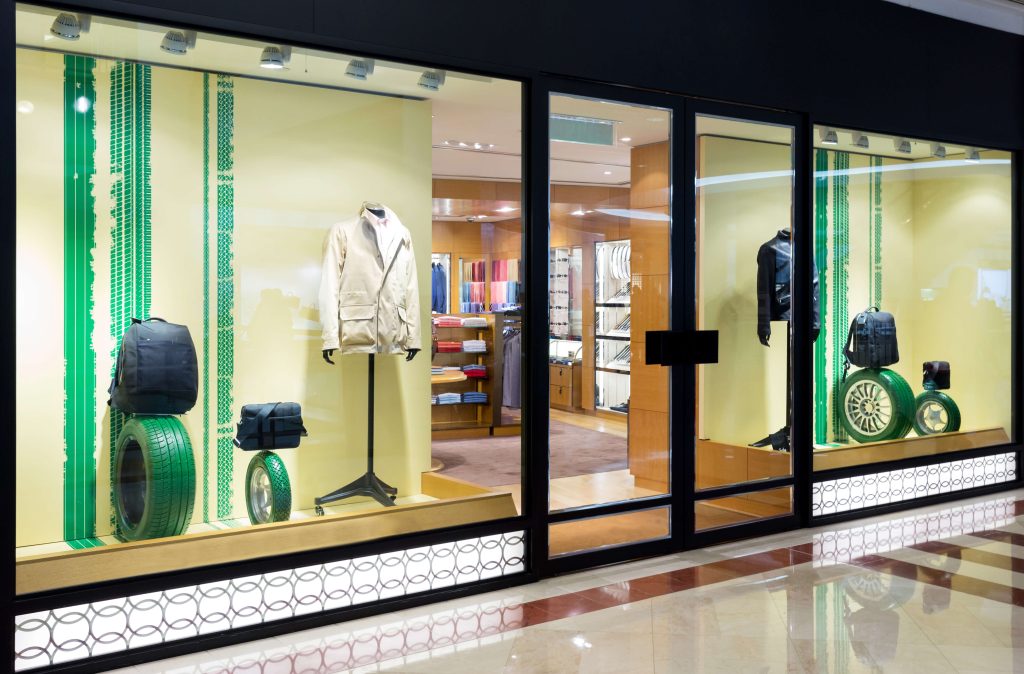
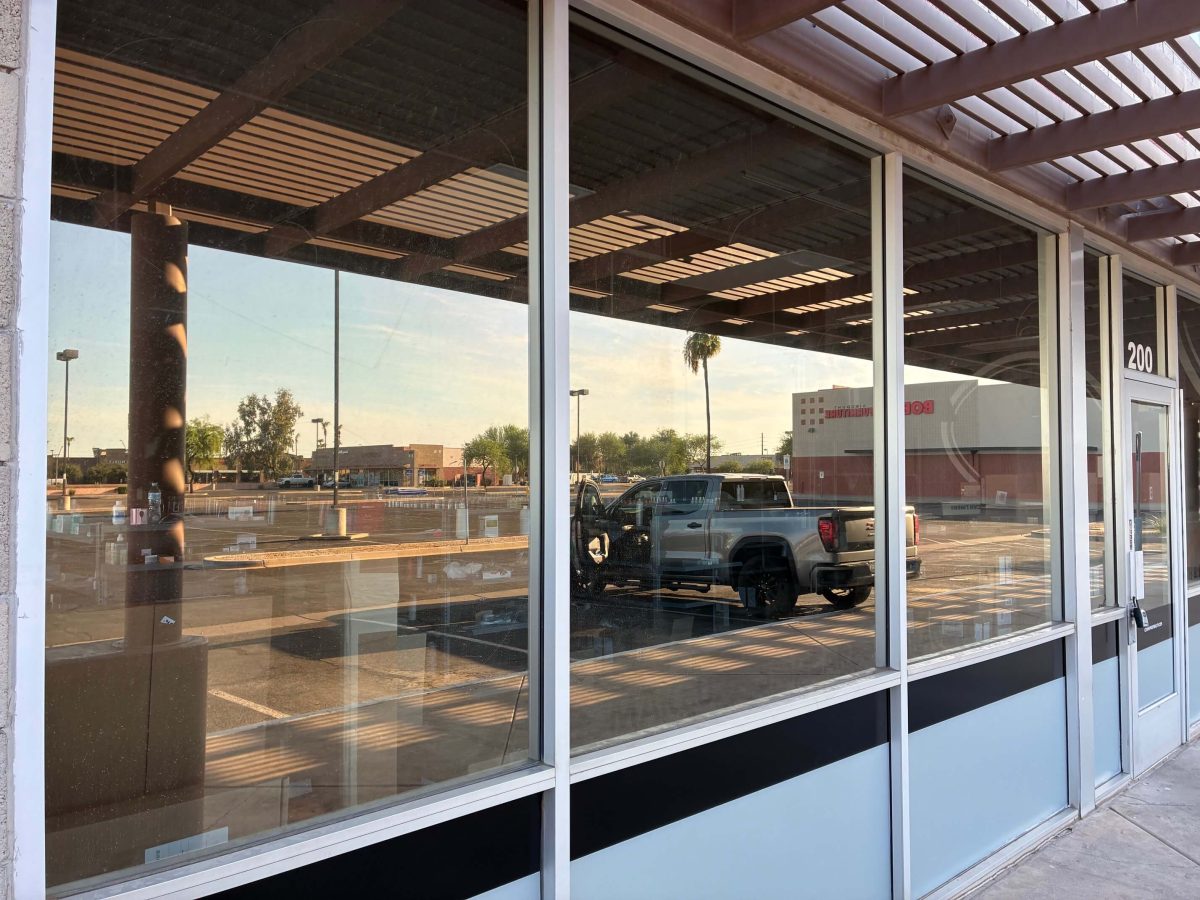
Storefront glass in Phoenix protected with professional security window film

What Film Type Does to the Price

Film choice moves the number, though usually less than the size of the job does. Across completed work, solar and heat-control film — including dual-reflective and reflective privacy film — has run between roughly $1,000 and $2,900 for most projects. Decorative and frosted work has run from about $450 to $2,900 depending on how much cutting is involved.

Specialty films such as security, safety, anti-graffiti and stained glass are quoted case by case. They are specified for a particular problem on particular glass, and we would rather give you a real number after looking at it than a range that turns out to be wrong.

If you are still deciding what the film needs to do, the specialty window film overview walks through each type and what it solves.

What Pushes a Quote Up

A few things reliably add to a job, and it is worth knowing about them before you compare bids:

Upper-tier and stairwell glass. Anything that needs a ladder, scaffold or lift costs more than work we can reach from the floor.

Removing failed film first. Scraping old, bubbled or purpled film off the glass before new film goes on is real labour, and it shows up in the price.

Exterior applications. Film applied to the outside of the glass is a different product and a different process from interior film.

Frameless and shower glass. Tight tolerances, no frame to hide an edge, and no room for error.

Custom decorative cuts. Logos, patterns and banding are priced by the complexity of the cut, not by the square footage.

What’s Included, and What’s Backed by Warranty

The on-site estimate is free, and so is the written quote that follows it. That quote scopes the job and lays out multiple options so you can compare them side by side rather than being handed a single number.

Residential window film comes with a lifetime warranty. Commercial window film comes with a 10-year warranty. We keep those two terms separate so homeowners and business owners each know exactly what protection comes with their installation.

Why the Cheapest Bid Usually Isn’t

The failure modes of cheap window film are well known: it peels at the edges, it bubbles, and it turns purple as the dyes break down under Arizona sun. Premium films carry manufacturer warranties against exactly those failures, and a low bid often means a film that carries no such coverage — or an installer who will not be around to honour it.

When that happens, the next job is not just installing film. It is scraping the old film off first, then installing film. You pay for the work twice.

How to Get an Accurate Number for Your Property

There is no way to price film properly over the phone, because the answer depends on glass we have not seen yet. Here is how it actually goes:

Call or book online, and we put a free on-site estimate on the calendar. At the estimate we review your glass, talk through what is bothering you — afternoon heat, glare on screens, fading floors, a lack of privacy — and work out which films do the job properly. You get a free written quote that scopes the work and gives you options. If you go ahead, we schedule the installation, do the work, and check back afterwards to make sure you are satisfied and know how to care for the film.

Common Questions

What does it cost to tint all the windows in a Phoenix house?

Whole-home projects generally run $1,800 to $5,000. Homes with a lot of glass, large sliders or upper-tier windows sit at the higher end. Most homeowners, though, do not film every window — they film the ones causing the problem, which usually lands between $1,000 and $2,000.

Do you take small jobs?

Yes, and we do a lot of them. A front door, a pair of bathroom windows, or one hot west-facing room typically runs $250 to $800. A single problem window is a perfectly normal job.

Is the estimate free?

Yes. The on-site estimate and the written quote that follows are both free, and there is no obligation attached to either.

What warranty comes with the installation?

Residential window film comes with a lifetime warranty. Commercial window film comes with a 10-year warranty.

Why do quotes from different companies vary so much?

Usually because they are not quoting the same thing. Different film lines, different mil thicknesses, interior versus exterior application, and whether removal of old film is included all change the number. Ask each company which film they are specifying and what the manufacturer warranty covers, and the quotes become comparable.

Where This Fits With Your Other Glass Decisions

If you know roughly what you want to spend and are working out what the film should do, start with residential window tinting or commercial window tinting. For a specific problem, we have detailed pages on UV and heat control, privacy film, one-way film, frosted film and decorative film, or you can browse the full specialty window film range.

Categories
Frosted Window Tint Residential Window Tint

Privacy Window Film in Phoenix: Why It Works by Day and Not at Night

Blog Article

Privacy Window Film in Phoenix: Why It Works by Day and Not at Night

calendar_today
By AZ Max Tint
AZ Max Tint - Storefront Window Tint - Commercial Window Film - Cosmo Pro - Privacy Window Film

The One Question Nobody Asks Until the Job Has Started

Here’s the part almost nobody asks about until after we’ve already started the job. Privacy window film works great during the day. At night, it behaves differently — and if you don’t know that going in, the first evening with your lamps on is an unpleasant surprise.

We tell every customer this upfront. We’re not going to let you think you’re getting something you’re not.

How Privacy Window Film Actually Works

Privacy film blocks the view from outside when there’s more light outdoors than in. That’s the whole mechanism. It isn’t magic and it isn’t a one-way mirror in the movie sense — it works off the light difference between the two sides of the glass.

With Phoenix sun blasting the outside of your glass most of the year, that difference is huge. Someone standing on your driveway at 2pm just sees a mirror. They can’t see you inside at all.

After Dark, the Physics Flip

At night, your lights are on inside and it’s dark outside. Now the brighter side is your living room, not the street. Film alone won’t block a clear view once that balance shifts.

Flip it at night with your lamps on and the glass turns into a mirror pointed the wrong direction. People outside can see in just fine. If your main worry is nighttime visibility, blinds or curtains do more for you than film alone.

Privacy window tint keeping a Phoenix interior bright while blocking views

The Fix Most Phoenix Homes Use

We had a homeowner near a busy stretch of road call us because her whole front room faced the street and she felt like she was on display every evening. Daytime, the film handled it. At night, we talked through adding blinds or curtains for after-dark hours, since that’s the honest fix.

So think of privacy film as your daytime solution, and a strong one at that. For nighttime coverage, most homes pair it with something simple like blinds. That combo — day film plus a light window covering at night — solves the problem completely. Nobody walking or driving by gets a clear shot into your home, no matter the hour.

Signs You Need Privacy Window Film in the First Place

Here’s how it usually starts. You’re walking past your own living room window at night and you realize anyone outside can see straight in. Or you’re at your desk in a ground floor office and customers walking by can watch every move you make. That’s the moment most people call us.

  • Ground floor bedrooms, bathrooms, or living rooms facing a street, walkway, or neighboring property
  • Home offices or storefronts where people outside can watch your screen, files, or point of sale area
  • Glass front doors or sidelights that let anyone at the porch see straight through the house
  • Pool or patio areas visible from a second story next door, or from a busy road
  • Conference rooms or private offices with glass walls facing a hallway or lobby

Not sure if your situation counts? If you’ve ever closed a blind just because someone might be looking, that’s your answer.

Which Film Goes on Which Window

Not every window needs the same fix. A bathroom window facing a neighbor’s patio is a different problem than a street-facing living room window in an Arcadia bungalow with big original glass. We look at the window first, then talk options.

Privacy window film is our go-to for windows where you want light in but eyes out — no distortion, just a soft frosted look during the day. Frosted window film and decorative window film work well for bathrooms, front doors, and glass panels near entryways where you still want some style, not just blackout coverage.

One-way window film is the answer we give a lot of business owners. It lets your staff see out while customers on the sidewalk can’t see in during the day. Mirror window film does something similar but with a more reflective look, popular on ground-floor offices along busy corridors.

Here’s the thing nobody tells you. Film that looks great on a north-facing window can behave completely differently once the Arizona sun hits it head-on all afternoon. That’s why we walk the property before recommending anything.

When Privacy Film Isn’t the Right Fix

So what if heat is really your problem, not people peeking in? That’s pretty common. Folks call us wanting privacy film but what they’re really annoyed about is a hot west-facing room in the afternoon. In that case, UV window film might be the better call — it cuts heat and glare without going as dark.

Renting your place? You’ll need the property owner’s sign-off first; most leases require it. And if you’ve only got one problem window, full privacy film across the whole property might be more than you need. Frosted film on just that spot can solve it without touching the rest of the glass.

One more thing. If your windows are already covered by security bars or thick landscaping that blocks sightlines, you may not need film at all. A quick look at the property tells us which situation you’re in.

Common Questions

Will privacy film stop my neighbors from seeing in at night too?

No. Privacy film works best during the day, not at night. It blocks the view from outside when it’s brighter outdoors than indoors. Once the sun goes down and your lamps are on, the glass can act like a mirror pointed the wrong way, showing the inside to anyone outside. If nighttime privacy is your main concern, blinds or curtains paired with film give you better coverage.

Do I need privacy film on every window, or just the ones people can see into?

Just the problem windows in most cases. If you’ve only got one bathroom window or a single street-facing office pane causing trouble, frosted film on that spot alone can fix it without touching the rest of your glass. Full coverage across a home or building makes more sense for storefronts or houses with several exposed windows.

My street-facing windows get hit by afternoon sun. Is privacy film still the right choice?

It depends on what’s bothering you more, heat or visibility. If afternoon sun is baking a west-facing room, UV window film might solve that problem better without going as dark as privacy film. But if your real issue is people on the sidewalk or a shared driveway seeing straight into your living room, privacy or one-way film is the better fit.

Where This Fits With Your Other Glass Decisions

Explore the full range of specialty window film we install across Phoenix, or go straight to privacy window film for the full service details.

Categories
Decorative Window Tint Frosted Window Tint Stained Glass Window Tint

Decorative Window Film in Phoenix: Frosted vs. Etched vs. Patterned vs. Stained Glass

Blog Article

Decorative Window Film in Phoenix: Frosted vs. Etched vs. Patterned vs. Stained Glass

calendar_today
By AZ Max Tint
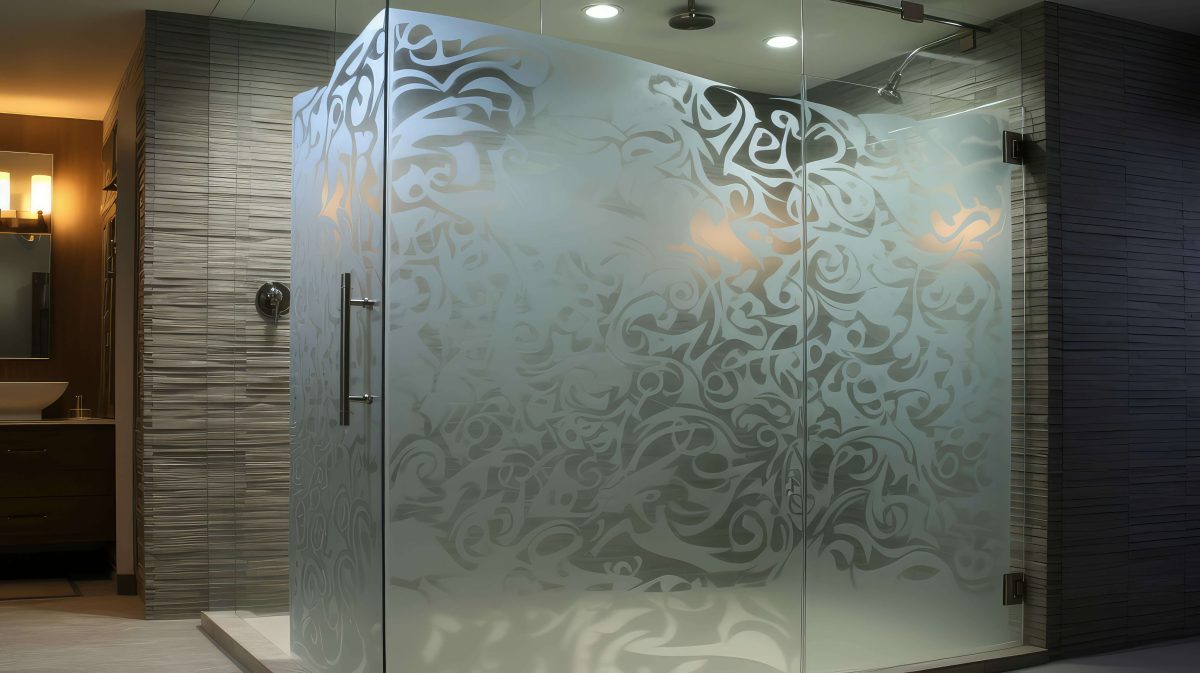
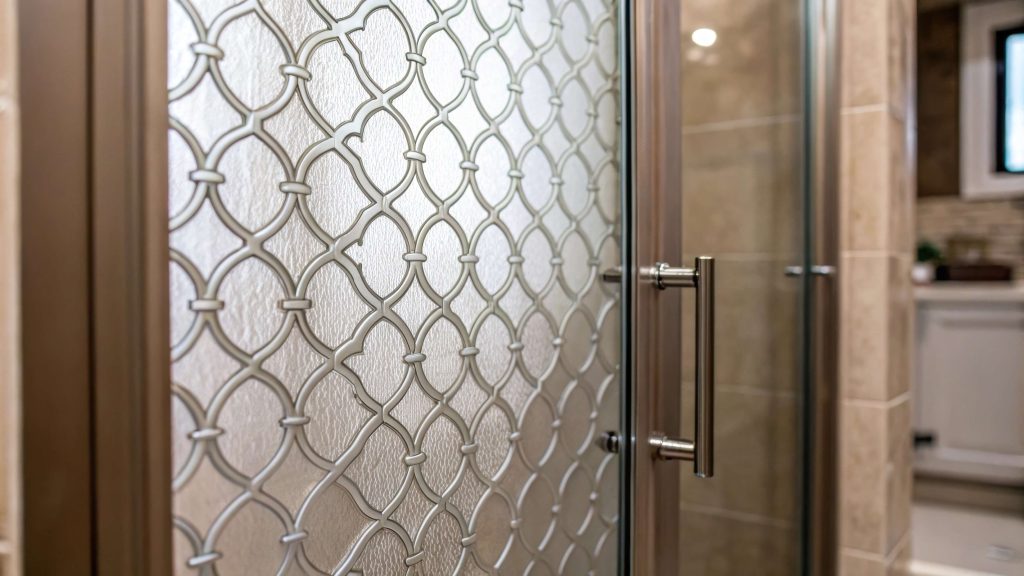
Decorative window film on a glass shower enclosure in a Phoenix home

Start With the Glass, Not the Photo

Choosing a decorative film style starts with matching the product to your glass type, not just picking a look you like in a photo. Four families of film cover almost every job we do in Phoenix, and they are not interchangeable.

Decorative window film does two jobs at once: it dresses up plain glass and it keeps people from walking straight into it. Homeowners use it on shower glass and interior doors, while offices use it on glass walls to add privacy and stop collisions. Both uses come from the same rolls of film, just applied differently.

Frosted Film

Frosted film delivers a soft, uniform privacy layer and works well on almost any flat glass surface, from bathroom windows to office sidelights. It is the simplest and most budget-friendly of the four, and it is what we reach for on windows, office glass and standard shower doors.

If your problem is a glass-walled shower with zero privacy, this is usually the answer. See frosted window film for the full service details.

Etched Film

Etched film mimics the look of sandblasted glass and often includes subtle texture variation that reads as more custom and higher-end. It suits entry doors, conference rooms and decorative accent panels where the glass is part of the first impression.

Patterned Film

Patterned film introduces repeating geometric or linear designs, which can visually elevate a plain glass door or partition. It requires precise measurement, since the pattern must repeat cleanly across the entire pane, and it works best on single, unobstructed glass.

Patterned decorative window film on interior glass in Phoenix

Stained Glass Film

Real stained glass is gorgeous. It is also thin, old, and one bad monsoon gust away from a crack that costs a fortune to fix. Stained glass window film gives you that same colored, leaded-glass look on your existing window. No fragile panels. No custom glasswork. Just film applied to the glass you already have.

Front doors, sidelights and bath windows are the most common spots. On older Phoenix homes in areas like Encanto and Willo with original leaded glass, we walk the glass carefully before recommending anything — film cannot fix a pane that is already cracked or has lead came pulling away.

The Short Comparison

  • Frosted film: best for simple, budget-friendly privacy on windows, office glass, and standard shower doors
  • Etched film: better for an upscale look on entry doors, conference rooms, and decorative accent panels
  • Patterned film: requires precise measurement and works best on single, unobstructed glass panes
  • Custom logo film: ideal for business branding but needs professional design proofing before installation
  • Frameless multi-panel showers: always require on-site templating to align patterns across seams

Why Frameless Showers Need Templating

This challenge shows up constantly in newer Phoenix construction, where large frameless glass shower enclosures have become standard in remodeled bathrooms and new builds across communities like Verrado, Estrella, and North Phoenix master-planned neighborhoods.

These oversized panels often span two or three seamed sections instead of one continuous sheet of glass, meaning any pattern or etched design has to align precisely across each seam to avoid an obvious visual break. Older Phoenix homes, by contrast, typically have smaller framed windows where slight pattern shifts are far less noticeable because the frame itself interrupts the sightline.

Design complexity affects feasibility far more than most homeowners expect. A simple frosted privacy strip on a single small window is straightforward. A detailed etched pattern spanning multiple panes, or a logo that must sit perfectly centered on an oddly shaped transom, demands careful layout work before a single piece of film is cut. Rushing that planning stage is the most common reason decorative film projects end up looking uneven.

Decorative window tint on residential glass in a Phoenix home

When Decorative Film Isn’t the Right Product

Decorative film solves a style problem. It is not built to solve a privacy problem or a heat problem, and we will tell you that straight up before you spend a dime.

Some decorative patterns still let outlines show through once the lights are on inside at night, especially the lighter, more open designs. If real nighttime privacy is your main goal, not the look, you will get better results from privacy window film or frosted window film instead.

Want an actual mirror effect on the outside, where people cannot see in during the day at all? That is a different job. Mirror window film is built for that. Decorative film will not get you there, no matter how dark the pattern looks.

Trying to cut down heat and glare pouring through a west-facing office window off Camelback Road? Decorative film adds style, but it is not doing the heavy lifting on heat rejection. UV window film is the one built for that job.

One more thing worth mentioning. If you are leasing space in a Phoenix office building or renting a home, check with your landlord or property manager before any glass work gets scheduled — some leases have rules about permanent changes to windows.

Common Questions

Will decorative window film keep my bathroom private at night?

It depends on the pattern you pick, and lighter designs can still show outlines once the lights are on. Frosted and etched styles block more than open, linear patterns do. If nighttime privacy matters more to you than the look, ask us about privacy or frosted window film instead. Decorative film is built first for style and safety, like stopping people from walking into glass, not for total blackout privacy after dark.

Does decorative film help with heat from Phoenix’s afternoon sun?

Not much, since decorative film is designed for style and pattern, not heat rejection. A west-facing office window still lets in strong heat and glare even with decorative film applied. If cutting down solar heat is your main goal, UV window film is the product built to handle that job. We are happy to combine both products on the same glass if you want style and heat control together.

Why do frameless shower enclosures need extra measuring?

Frameless showers often span two or three seamed glass panels instead of one solid sheet. Without a frame to break up the sightline, any pattern or etched design has to line up exactly across every seam. Older homes with smaller framed windows hide small pattern shifts easily. Frameless glass does not, so we template on-site before ordering film.

Where This Fits With Your Other Glass Decisions

Explore decorative window film, frosted window film and stained glass window film, or see the full range of specialty window film we install across Phoenix.

Looking for the commercial version? See frosted and decorative window film for Phoenix offices.

Categories
Projects Residential Window Tint Turf Burn Protection

Turf Burn Protection Film In Gold Canyon: Stopping Window Reflection From Burning Artificial Grass

PROJECT POST

Turf Burn Protection Film In Gold Canyon: Stopping Window Reflection From Burning Artificial Grass

October 6, 2026

A homeowner in Gold Canyon came to us through our website with a problem most people have never heard of until it happens to them: their artificial grass was burning, and the windows were doing it. This is a little bit different than usual issues that home window tinting solves.

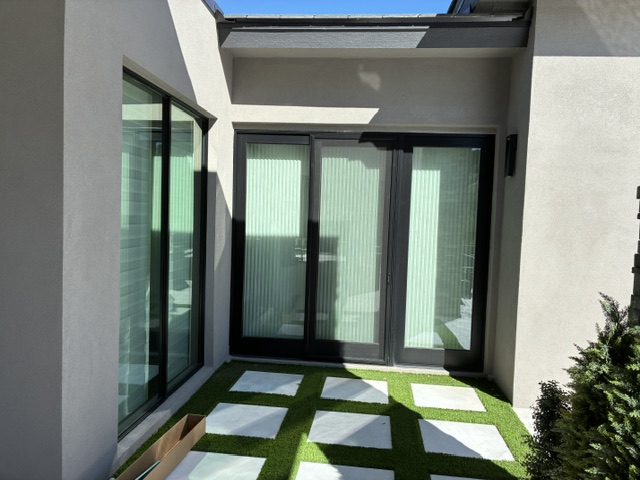
Not sun damage in the general sense. A defined area of melted, warped turf, caused by sunlight reflecting off the glass of their own house and landing back on the lawn. There are several window tint options for solving this problem. We installed Pristine 70 on the exterior of five windows facing south and east, and the burning stopped.

Exterior window film on a Gold Canyon, Arizona home installed to stop window reflection from burning artificial grass

The Problem: Windows That Melt Your Lawn

Turf burn from window reflection is a real and increasingly common problem, and it surprises people every time. The homeowner usually blames the turf, the installer, or the Arizona sun in general. The actual culprit is the glass.

Modern energy-efficient glazing is built to reflect solar energy rather than let it into the house, which is exactly what you want for your cooling bill. That reflected energy has to go somewhere. When it comes off a south- or east-facing pane at the right angle, it lands on whatever is in front of it, and if the pane has any slight bow to it, that reflection can be concentrated rather than scattered. Artificial grass is a synthetic fiber. Concentrated reflected sunlight is more than it can take, and the result is a scorched or melted strip across the lawn that will not grow back, because it was never growing in the first place.

Why This Keeps Happening In Gold Canyon And The East Valley

Gold Canyon sits out past Apache Junction at the foot of the Superstitions, and like much of the east Valley it is full of newer homes built with energy-efficient glass and landscaped with artificial turf instead of grass that needs watering. Those two choices are individually sensible and occasionally a bad combination.

Add the Arizona sun, which is stronger and higher-angle than almost anywhere else these products get installed, and you have the conditions for turf burn: reflective glass, synthetic lawn, and an enormous amount of solar energy to work with. We see it across Gold Canyon, Apache Junction, Queen Creek, Mesa and the wider Phoenix metro, almost always on south- and west-facing elevations and almost always on homes under fifteen years old.

The AZ Max Tint Solution: Pristine 70 On The Exterior

Tom specified Pristine 70, and the homeowner went with the recommendation.

The critical detail on this project is not the film. It is where it went. The film was installed on the outside of the glass, not the inside.

That is the opposite of a normal window tint job, and it is the only thing that works for this problem. Interior film sits behind the glass, so the sunlight has already hit the exterior surface and bounced away before the film has any say in it. Interior film is excellent at managing what comes into the house and does nothing at all about what reflects off it. Stopping a reflection means treating the surface doing the reflecting, which means going outside.

Five windows on the south and east elevations were treated, which were the ones putting reflection onto the turf.

Why 70 And Not Something Darker

Pristine 70 is a light film, and that is deliberate. The homeowner’s problem was not heat inside the house and it was not glare. It was one specific reflection hitting one specific area of lawn. Treating that does not require darkening the windows of the home, changing how the house looks from the street, or reducing the light inside the rooms. The right fix for a turf burn problem is the lightest film that interrupts the reflection, not the darkest film available.

The Installation

Damon and Sam handled the install across the five affected windows.

Exterior film work is its own discipline. The installer is working on the weather side of the glass, where dust, wind and direct sun all have a say in how clean the application goes, and where the film has to be set without contamination in conditions that are actively trying to contaminate it. It is a different job from standing in an air-conditioned living room working on the inside of the same pane.

What The Film Did For This Home

  • Stopped the reflection that was burning the artificial turf
  • Protected the remaining lawn from further damage
  • Left the appearance of the house essentially unchanged, with no dark or mirrored look
  • Kept interior light levels where the homeowner wanted them
  • Addressed the cause at the glass rather than working around it with shade sails or relocated landscaping

The Finished Result

No more burning. The turf that survived is safe, and the homeowner did not have to re-landscape, rebuild a section of lawn every summer, or put up a structure to block their own windows.

If you have artificial grass with a melted stripe across it, look at the windows facing that stripe before you blame the turf. Our turf burn protection film page explains how we diagnose and treat it, and our residential window tinting page covers the rest of what film can do for a Phoenix-area home. The full range of window film options is there too.

Get A Window Tinting Estimate From AZ Max Tint

If heat, glare, UV exposure, privacy, reflection damage or excessive sunlight is making your Phoenix-area home or commercial property less comfortable, AZ Max Tint can help you find the right window film for your space.

Call AZ Max Tint: (480) 913-5889
Contact AZ Max Tint: https://azmaxtint.com/contact

For directions to AZ Max Tint, just click here.

Visit Us From Gold Canyon

Driving directions from Gold Canyon, AZ 85118 to AZ Max Tint at 3734 E Kristal Way, Phoenix, AZ 85050.

Get A Fast FREE Estimate

Enter Your Information Below

Get A Fast FREE Estimate

Enter Your Information Below